
New Documentary: Seeking the Elusive Black Swift in Montana
June 13, 2025
For over 10 years, Montana Audubon has been monitoring Black Swift populations across the western portion of the state. These birds can be a challenging species to observe and monitor. They are aerial insectivores that tend to feed at high altitudes, and they nest in remote, hard-to-access locations: behind snow/glacial-fed waterfalls.
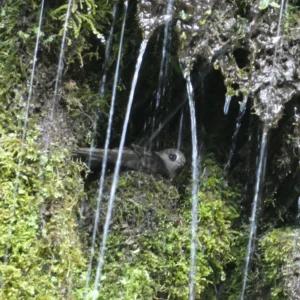 In this new documentary, Montana Audubon’s Director of Conservation, Christian Meny, and Avian Specialist, Bo Crees, share the story of Black Swifts in Montana, and Montana Audubon’s effort to monitor them.
“The Black Swift is a really unique species, there’s basically nothing like them in North America,” said Crees. Because these birds are so aerial, the only time effective surveys can be conducted is at dawn or dusk, when the birds fly in and out of their nests before or after foraging. “One of the things that makes our surveys challenging is that we’re trying to see a bird that flies around 90 mph, 100 mph, coming to a nest in low light conditions, around dark cliffs, when it’s dark outside, the bird itself is black, and if you blink for a second there’s a good chance you miss the bird.”
One of the biggest threats to Black Swifts in the Northern Rockies is the loss of glacier-fed waterfalls due to climate change. Already designated as endangered in Canada, Black Swift populations have declined by at least 50% since 1973. Montana Audubon’s Black Swift project informs conservation and supports the advancement of climate strategies and solutions on this species’ behalf.
“The story of the Black Swift is an important one: of all species in the world, the Black Swift may be more directly impacted by climate change than any other,” said Meny. Later, he adds: “We may be documenting the decline of a species in real time, and that’s a really important story to tell.”
Watch the documentary:
Special thanks to our funding and conservation partners: the Cross Charitable Foundation, the Cinnabar Foundation, Tracy Aviary, the Bird Conservancy of the Rockies, Montana Fish, Wildlife & Parks, the Black Swift Monitoring Network, the many volunteers, and the biologists at Glacier National Park.