In the Field with a Citizen Scientist: Nighthawk Survey
August 26, 2025
This article was originally published in the Yellowstone Valley Audubon Society Flyer (August 2025). Reprinted by permission from YVAS and the author.
By Bernard Quetchenbach
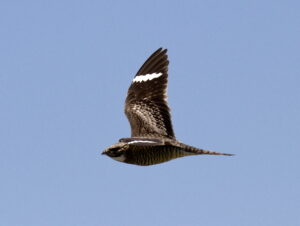
Common Nighthawk is a Species of Greatest Inventory Need in Montana, so Montana Audubon, with support from Montana Fish, Wildlife, and Parks and Tracy Aviary in Salt Lake City, is conducting a statewide survey to assess their breeding population status. On the evening of July 7, surveying conditions seemed perfect: clear skies, not much wind, and a nearly full moon, preferred by nighthawks for better hunting visibility.
Most routes consist of ten stops, one mile apart, but our predetermined Red Lodge course had only nine. At each one, Cara and I set our timers for six minutes and stepped out of the car, roaming off in different directions so that our results could be considered independent. The first stops featured Vesper and Savannah Sparrows, an Eastern Kingbird, and distant lowing cattle, but no nighthawks.
My first nighthawk showed up at the third stop, right around sunset, and their buzzy calls were heard at several later stops. I recorded each “peent” detection, and did my best assessing distance and direction, no small task with a moving, stubbornly invisible bird in increasing darkness.
Though Common Nighthawk was the target species, we also recorded “Incidentals” from a pull-down list provided on the Survey123 app. I was a bit disappointed to find that Savannah Sparrows were not on the list since they were scarce on the route I had covered for the Breeding Bird Survey a couple of weeks earlier, but I was pleased to find them in good numbers here. One species that was included was Wilson’s Snipe, which, as we confirmed later, we had both heard winnowing in the distance at a couple of stops.
By the time we got to Stop Six we were getting uncomfortably close to the end of the survey time window, from an hour before sunset to ninety minutes after. Without benefit of road signs, we found it challenging to keep to our route, relying on the app’s latitude and longitude readings. This was also the part of the route we missed on our earlier scouting trip as heavy rain that night turned the dirt roads into a treacherous gumbo slurry. Perhaps inevitably, we took a wrong turn, continuing for a mile or so before correcting course. We did, however, encounter our first Common Poorwills along this accidently traveled stretch. We found one more of these nighthawk cousins and official Incidentals, complete with pink eyeshine, back on the right dirt road before running into deep, waterfilled pits in a low-lying creekside area. Cara, who was driving while I navigated with the app’s GPS coordinates, heroically skirted a few of these obstacles, but we reached a place where the road was completely flooded with no clear path forward.
Though we couldn’t reach our final two stops, we did find nighthawks and other birds of interest. We also discovered new-to-us corners of our own regional habitat. Our sighting logs were not identical, illustrating the wisdom of having two independent records from the same route. Having to retrace our steps back to Red Lodge in the dark, keeping an eye out for poorwills and the occasional rabbit, we didn’t arrive home in Billings until midnight.
Learn more about Nightjar Surveys on our Citizen Science website.
Thank you to Tracy Aviary for funding this project!