A Look at Conservation Ranching Projects
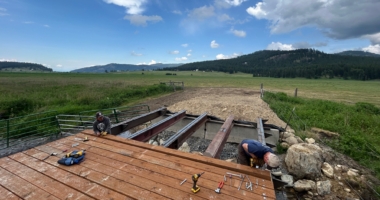
With 2026 around the corner, we’re reflecting on the progress made through the Audubon Conservation Ranching program, and specifically, one of our first infrastructure projects designed to benefit birds and Montana’s waterways.
Thanks to funding from the Department of Environmental Quality’s (DEQ) Nonpoint Source Program, we helped the Wade family at Montana Better Beef (MTBB) build a bridge and create a riparian buffer on their ranch in Kila, MT. The ranch sits on Truman Creek, an important spawning tributary for Westslope Cutthroat Trout, which runs directly into Ashley Creek to Smith Lake Waterfowl Production Area before heading to Kalispell.

Landowner Pete Wade (supervised by his dog) working on the bridge in July 2025.
A bridge, you might ask? How does that help birds? There are two primary reasons:
First, cattle could only reach this part of the ranch by crossing directly through the creek, which runs the risk of degrading water quality downstream through erosion and nutrient pollution. Pairing the bridge with a riparian buffer zone will help achieve DEQ’s goal of reducing nutrient loads in the watershed.
Second, and maybe most importantly for grassland birds, the bridge has reduced haying across the ranch because the cattle are now able to graze this pasture earlier in the year. In the spring and summer, when the water is either frozen or too high for cattle, landowner Pete Wade had to hay the other side to ensure his cattle were getting enough feed. Now that cattle can safely cross he can graze the pasture, which leaves more vegetative cover and reduces impacts to ground nesting birds.
Additionally, the project created a buffer zone around the creek to allow for regeneration of the riparian areas, helped by Wade’s planting of hundreds of native trees and shrubs.

Montana DEQ staff and rancher Pete Wade examine plants in his reseeded pasture.
As part of the grant, Montana Audubon staff conducted bird and vegetation monitoring in 2024 and 2025. We recorded 34 total species on 3 points, including riparian species like Song Sparrow, Yellow Warbler, Bullock’s Oriole, and even nesting Mallards; several raptors, including Northern Harrier, American Kestrel, and Merlin; and a significant number of Savannah Sparrows in the surrounding pastures! Last summer, we even got the chance to meet DEQ staff as they ran bank stabilization and erosion models. We will complete our final surveys in 2026, and plan to continue monitoring bird populations across the ranch for years to come as part of the Conservation Ranching Program.

The stream crossing in September 2023, before the bridge was built.

The same location in July 2025, after the completion of the bridge.
Pete Wade, his daughter Lisa, and son-in-law Oscar, own and operate Montana Better Beef as a grass-fed organic operation and direct to consumer business in Kila, MT. If you would like to learn more about their business or purchase some of their beef, you can learn more at montanabetterbeef.com.
Special thanks to DEQ and their Nonpoint Source Program staff for their dedication to this project. We look forward to sharing updates on this project and more from the Conservation Ranching Program in the future!
For more information:
Learn more about the Audubon Conservation Ranching program in Montana
Learn more about Montana Better Beef
- Article: Audubon Conservation Ranching- MT DEQ Funds Truman Creek Restoration at MT Better Beef Ranch | Oct. 13, 2023
- Article: Truman Creek Restoration Continues on Montana Better Beef Ranch | July 17, 2024
Learn more about the Montana Department of Environmental Quality’s Nonpoint Source Program
