
We use the best available science to ensure the survival of Montana’s birds and other wildlife.
Black Swift Surveys
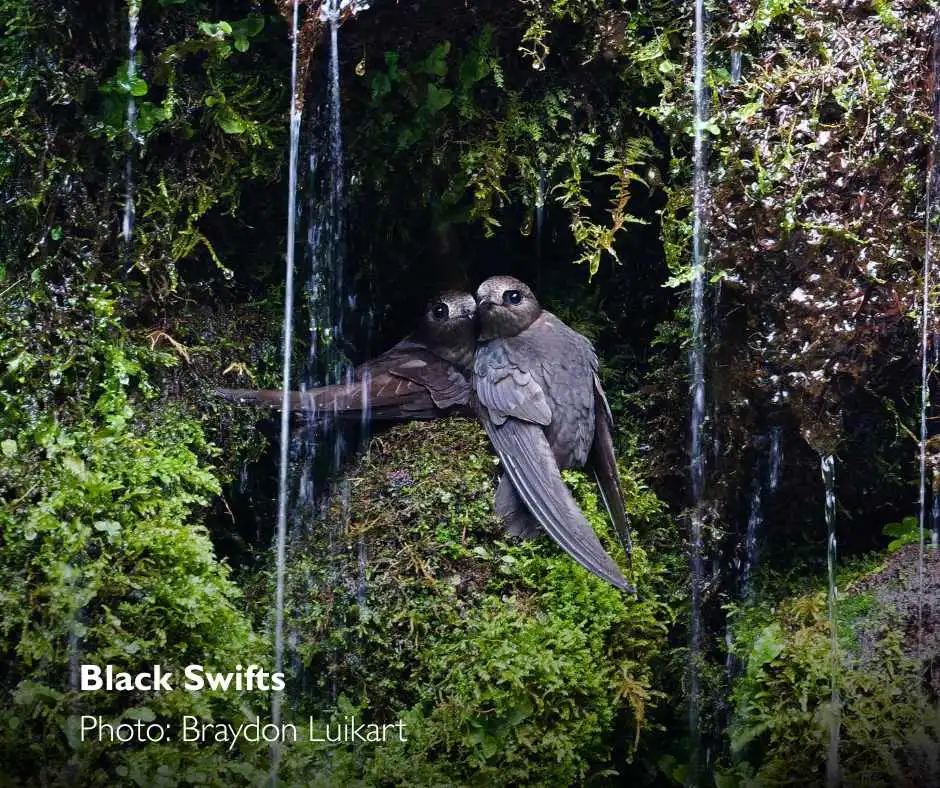
Black Swifts were the last avian species described in North America, discovered in 1857, and were one of the most mysterious until their interior western North American waterfall nesting habitat was discovered in 1919.
It took until the 1960s for Black Swift nesting sites, or nesting colonies, to be discovered in Montana, and up until 2015, there were still just seven known sites.
Not surprisingly, the Black Swift is listed as a state species of conservation concern, and a state species of greatest inventory need.
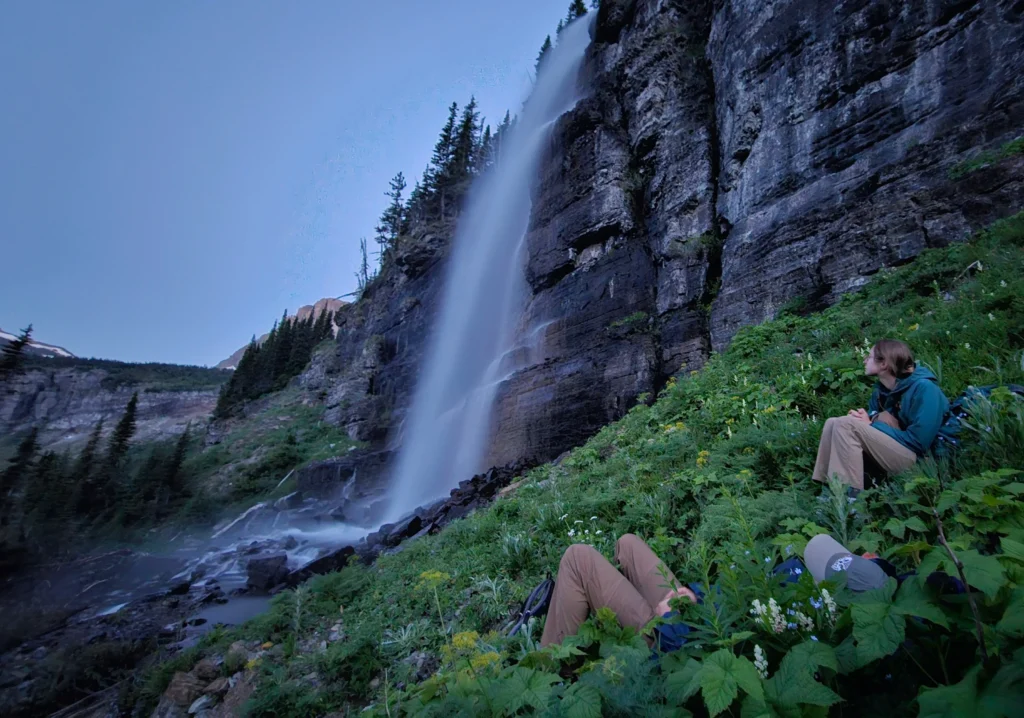 Since the 2014 field season, Montana Audubon has been monitoring Black Swift populations across the western portion of the state.
These birds can be a challenging species to observe and monitor. Despite being the largest swift in North America, they are difficult to spot. Black Swifts almost always nest behind high altitude, glacial-fed waterfalls. As aerial insectivores they feed at high altitudes during the day, leaving the nest around sunrise and returning in the evening, which means surveying takes place until dark and begins well before the sun is up.
Outside of the breeding season, Black Swifts spent most of their time in the air, and rarely touch down at all 9 months of the year. One Black Swift that was tagged in Colorado remained on the wing without landing for 10 straight months.
One of the biggest threats to Black Swifts in the Northern Rockies is the loss of glacier-fed waterfalls due to climate change. Already designated as endangered in Canada, Black Swift populations have declined by at least 50% since 1973. Montana Audubon’s Black Swift project informs conservation and supports the advancement of climate strategies and solutions on this species’ behalf.
Special thanks to our funding and conservation partners: the Cross Charitable Foundation, the Cinnabar Foundation, Tracy Aviary, the Bird Conservancy of the Rockies, Montana Fish, Wildlife & Parks, the Black Swift Monitoring Network, the many volunteers, and the biologists at Glacier National Park.
Documentary: Seeking the Elusive Black Swift in Montana
Reports
Black Swift survey reports from Glacier National Park
Black Swift survey reports across Montana
Recent Research News
Earlier this year, Christian Meny, Montana Audubon’s Director of Conservation, was a co-author on a paper that highlights IMBCR and its effectiveness. The paper, titled “Monitoring at management scales: Multi-scale trend estimates for bird populations in the western United States,” was published in the journal Ecosphere.
In this new documentary, Montana Audubon’s Director of Conservation, Christian Meny, and Avian Specialist, Bo Crees, share the story of Black Swifts in Montana, and Montana Audubon’s effort to monitor them.
 In July, the Montana Audubon Black Swift research team started Black Swift surveys in MT. Here, they share what it’s like to be in the field- be sure to check out the video at the end!
Staff Contacts